Why Most Follow-Up Messages Get Ignored
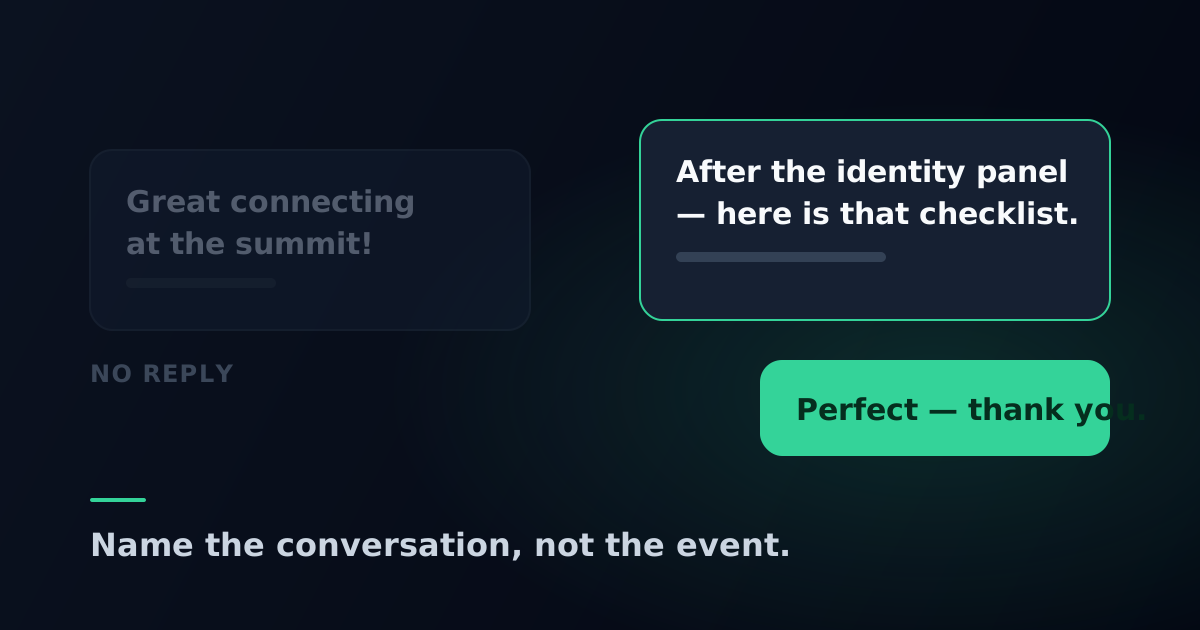
Here is the thing most follow-up advice misses. You spent the event worrying that you would forget people. The person you are emailing on Tuesday has exactly the same problem, and you are one of the forty faces they cannot place.
So the first line of your message is not an introduction. It is a memory aid for somebody who is quietly hoping you will make it obvious who you are.
That single shift fixes most bad follow-ups. “Great connecting at the summit!” gives them nothing to work with. “We talked about consent tooling after the identity panel, by the coffee” puts them back in the room.
Send it when it is useful, not when it is fast
The advice to follow up within 24 hours has become a reflex, and it produces a lot of messages that exist only to be prompt.
- Same day if you promised something they need immediately, or you are confirming a meeting.
- Two or three days if you are continuing a conversation. The event noise has cleared and they are back at a desk.
- On the date you gave if you named one. That date beats every general rule here.
Missing a day matters far less than being unplaceable.
Four parts, in this order
- Where you met. The session, the stand, the queue. Something they can picture.
- What you actually talked about. One specific detail, theirs not yours.
- The useful thing. The link, answer, or introduction you said you’d send.
- One next step. Small, and only one.
Hi Anika — we met after the identity panel at Fintech Forum. You mentioned your team was comparing consent-management tools. Here’s the checklist I said I’d send. If it’s helpful, I can introduce you to the people who built it.
Four sentences. She knows who is writing, why, and what happens next.
Templates, if you want a starting point
Sending what you promised
Hi [Name] — good talking at [where]. Here’s the [thing] I mentioned when we were discussing [topic]. Hope it’s useful.
Making an introduction
Hi [Name] — following on from [event]. You said you were looking for [need]. If you’re happy for me to, I’ll introduce you to [person], who [reason].
Asking for time
Hi [Name] — I enjoyed the conversation about [specific thing] at [event]. Would twenty minutes next week be useful to go into [clear purpose]? I’m free [two options].
Closing the loop
Hi [Name] — I said I’d send [item] today. Here it is. No reply needed.
That last one is underrated. Delivering a small promise on the day you named does more for a new relationship than any amount of enthusiasm.
Five ways to lose the reader
- A bulk message wearing a first name as a disguise.
- Three paragraphs about your company before anything about them.
- Two or three asks stacked in one message.
- Adding them to a mailing list because you have their card.
- “Just checking in,” which tells them you have nothing new to say.
The follow-up starts at the event
The reason follow-ups drift into vagueness is that the material for a good one was never captured. By Tuesday you have a name and a company and a fading sense that the conversation was worthwhile.
Record the promise when you make it, with a date attached. “Send the security brief by Thursday” is something you can act on. “Follow up soon” is a feeling.
Faydo Connect keeps who you met, where, what you discussed and what you promised in a private notebook on WhatsApp. You can ask it what you owe people, and the answer comes back with the context you need to write the first line.