You Only Need Six Good Conversations at an Event
The standard advice before a conference is to work the room. Arrive early, stay late, talk to everyone, collect as many cards as you can carry.
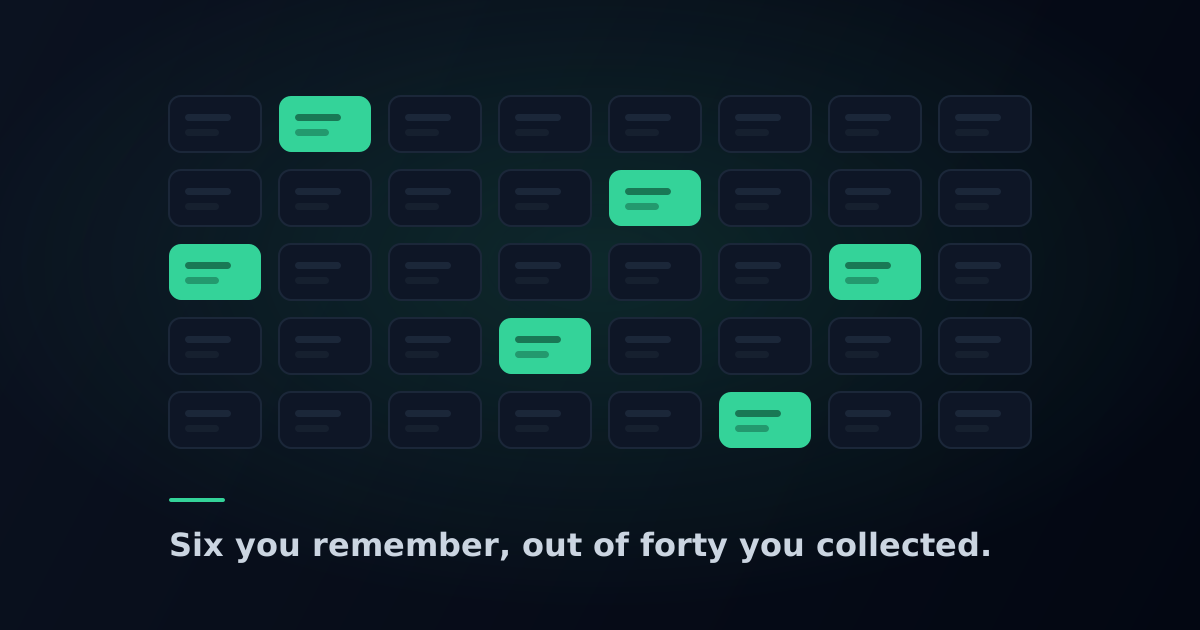
Watch who actually walks out of a two-day event with something. It is almost never the person carrying the most cards. It is someone who had six conversations, remembers all six, and has two calls in the diary by Wednesday.
Volume is the easy metric, which is why everyone reaches for it. It is also the one that leaves you on Monday morning holding forty rectangles of cardboard belonging to strangers.
Decide your one sentence on the train
Before you walk in, finish this: I came here to ___.
- I came here to meet founders who sell into banks.
- I came here to understand how three teams handle KYC.
- I came here to find two distribution partners.
It does two jobs. It tells you who to walk towards, and it gives you a real answer when somebody asks what brings you here — which beats “oh, just seeing what’s happening.”
Vague intent is most of the awkwardness. You feel like a nuisance because, without a reason to be in the conversation, you are.
The opening line is the room you are both standing in
There is no clever line. Nobody has ever been impressed by one. You are both standing in the same hall having just sat through the same panel, and that is enough material.
- “What brought you to this session?”
- “What does your team work on?”
- “Found anything worth seeing yet?”
Then listen for one specific thing and ask about that. Most conversations at events die because both people stay in headline mode — company, title, elevator pitch — and never get to the part where somebody says what is actually hard this quarter. One real follow-up question gets you there.
Say what you do in one breath
Long enough to be understood, short enough to invite a question:
“Faydo Connect remembers who you met, where, and what you promised. It runs on WhatsApp, so there is no app.”
Then stop talking. If they are interested, they will ask. If they are not, you have given them an easy place to change the subject, which is a kindness.
The temptation is to keep going while you have their attention. Resist it. A pitch that runs past its welcome is the reason people brace when they see a lanyard coming.
Leaving is a skill nobody teaches
Most awkwardness at events is not in the hello. It is in the slow death of a conversation that finished two minutes ago while both people search for an exit.
End it while it is still good:
- “Glad we met — I’m going to catch the next session.”
- “I’ll let you meet a few more people. Can I send you that link tomorrow?”
- “This was useful. Let’s swap details and pick it up next week.”
Nobody has ever been offended by this. Everyone is relieved.
The twenty seconds afterwards
Step aside and say one sentence out loud, into your phone, before the next handshake:
“Met Kunal from Kustodian Life at their stand — they recover stuck PF and unclaimed shares. Send him my UAN by Friday.”
Who, where, what, and what you owe. That is the whole thing.
Leave it until the evening and you will be reconstructing four similar fintech conversations from a pile of cards, in a hotel room, tired. The details that made each person worth remembering are exactly the ones that go first.
Faydo Connect turns that voice note into a private notebook entry on WhatsApp — no app to install, and nobody else can read it. Weeks later you ask in plain words: who helps with stuck PF?
The rule for the day
Six conversations you still remember beat forty you do not. You are not there to be remembered by everyone. You are there to remember the right few.