Why You Forget People You Meet at Events
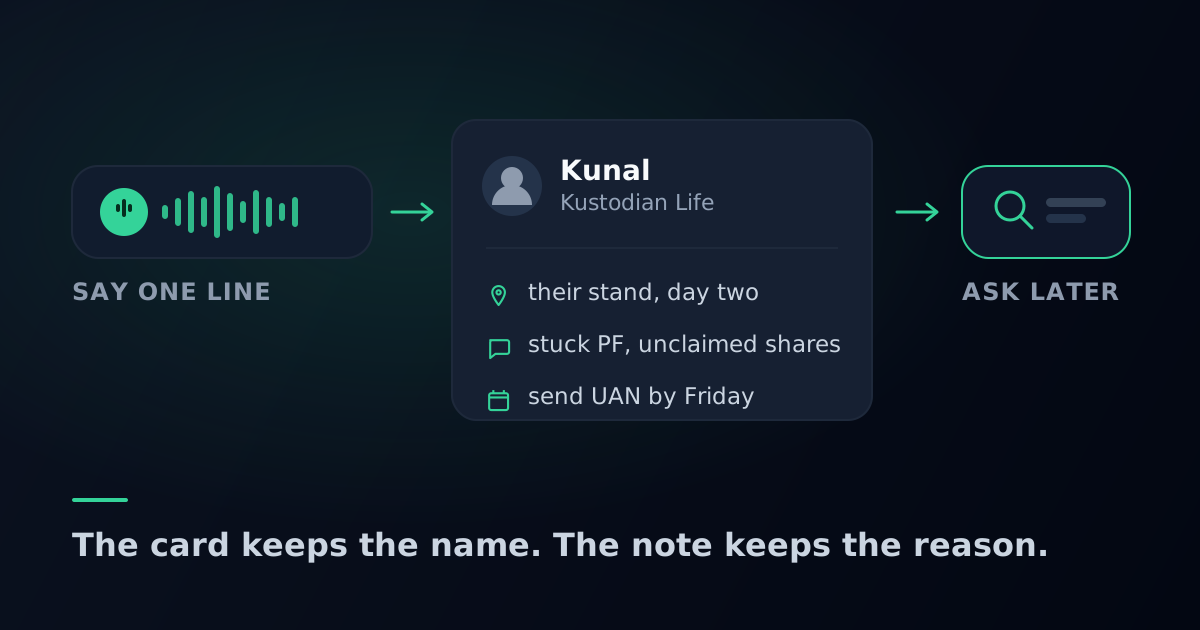
You are not bad with names. A conference is simply an unreasonable thing to ask a memory to do.
Thirty conversations in two days, most of them in the same hall, many with people who work on adjacent problems and describe them in adjacent language. Your memory stores things by what makes them different. An event is engineered to remove the differences.
By Monday you have a bag of cards and four faces. The two are not reliably connected.
The detail that goes first is the one you needed
Watch what survives and what does not. Names and companies hang on for a while, because they are printed on something. What evaporates within hours is everything that made the person worth a follow-up: the problem they were stuck on, the person they asked to be introduced to, the thing you said you would send.
Which is backwards. The card already carries the name. Nothing carries the reason.
One sentence, four parts
After a conversation worth keeping, say one sentence out loud into your phone:
“Met Kunal from Kustodian Life at their stand — they recover stuck PF and unclaimed shares. Send him my UAN by Friday.”
- Who — name, role, company.
- Where — the stand, the session, who introduced you.
- What — the specific thing you discussed.
- Next — what happens, who does it, by when.
Ten seconds. And it answers questions you will actually ask later, like who was the PF person? and what did I promise this week? — neither of which a contact card can answer.
Do it before the next handshake
This is the part people skip, and it is the part that matters.
Recorded in the moment, the note costs you nothing and is accurate. Left until the evening, it becomes an act of reconstruction in a hotel room at 11pm when you are tired, and the conversations have already started merging into each other.
So step aside, say the sentence, walk back in.
A saved contact is not a memory
A phone contact stores identity. A useful note stores the relationship.
| A contact saves | A note adds |
|---|---|
| Name | Where you met |
| Company | What you discussed |
| Phone or email | What they need |
| Job title | The next step, and the date |
Everything in the left column is on the card. Everything in the right column exists only in your head, for about six hours.
The card is not the conversation
Someone hands you a visiting card. It goes in the bag, and the bag is where context goes to die.
Before it disappears, add the sentence. Where you met, what they need, what happens next.
With Faydo Connect the other person needs nothing — no app, no QR code, no account. Send a photo of the card on WhatsApp and Faydo reads it back for you to correct before saving; or just say who you met and it writes the note. Either way the notebook is private, and nobody else can read it or be found in it.
The habit, not the system
Step aside. Say one sentence. Include the next action. Check what you owe when you get home.
The best system here is not the most thorough one. It is the one you will still bother with on day two, walking between stands, holding a coffee.