How We Built Faydo Connect Around India's DPDP Law
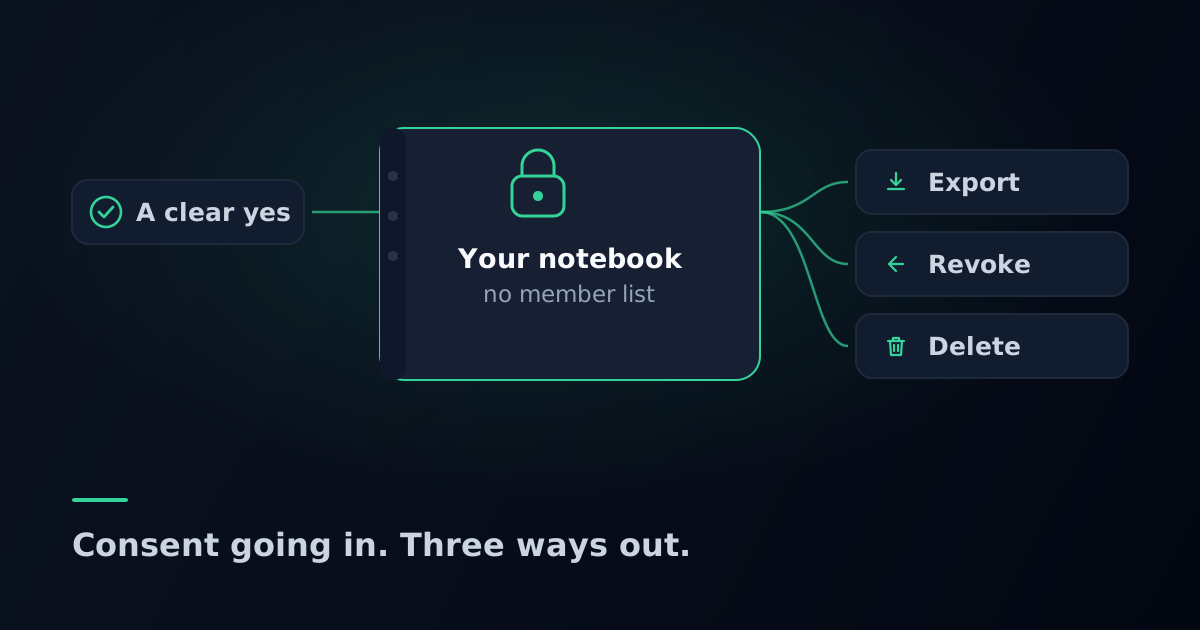
Event networking has a privacy problem built into it. You want to remember a good conversation. You do not necessarily want your phone number in an attendee list, a sponsor’s CRM and four follow-up sequences you never agreed to.
Those are two separate jobs, and most networking tools collapse them into one. Faydo Connect keeps them apart: a private note helps you remember who you met and what you promised; giving someone your number is a different decision, made separately.
That separation is also, more or less, what India’s data protection law asks for.
Where the law actually stands today
India’s statute is the Digital Personal Data Protection Act, 2023 — the DPDP Act, or DPDPA. The Digital Personal Data Protection Rules, 2025 were notified in November 2025, and commencement is phased: the notification brings different provisions into force on publication, one year after publication, and eighteen months after publication.
So as of 23 September 2026, some institutional provisions are live while many of the core processing duties and individual rights are still scheduled. Plenty of products are waiting for those dates.
We did not, for an unglamorous reason: consent, minimisation and revocation are architectural. Retrofitting them means rebuilding how data moves through the product, not adding a checkbox. It is far cheaper to be built this way from the start.
What follows describes product design. It is not a government certification, and it is not a legal opinion.
A narrow purpose, said out loud
The framework starts with a specified purpose, and ours is small enough to state in a sentence: remember the people you meet and the promises you make.
After a handshake you say one line into WhatsApp. Faydo writes a private note — person, place, discussion, next action. Weeks later you ask for them in plain words and the note comes back.
That is the entire purpose. The note is a memory aid. It is not permission to message that person, publish them, or add either of you to a marketing list.
A notebook, not a directory
Two promises sit on the product page: your notebook is private, and there is no member list — not for sponsors, not for us.
That boundary is the one most event tools cross. Helping you remember your own conversation does not require making every attendee searchable by every other attendee, and the moment a product builds that index it has created something it will eventually be asked to hand over.
There is also nothing that lands on your phone unasked. No cold approaches.
The card carries a card’s worth of information
Faydo’s QR card is optional — you get one if you ask for one. It carries what a paper business card carries: name, role, company. Not your phone number.
Scanning it starts an exchange. It does not disclose the number behind it, which is what a lot of digital cards quietly do.
Sharing needs a clear yes
The Act describes consent as specific, informed and unambiguous, given by clear affirmative action. In the product that is one moment after a scan:
- Accept swaps numbers.
- Pass shares nothing, and needs no explanation.
One person, one tap. Which is deliberately unlike a registration checkbox that releases an entire attendee list to everyone who paid for a stand.
Each share writes one line to a ledger only you can read, so the answer to who has my number? is a record rather than a memory.
Changing your mind ends access, not history
Withdrawing consent should be as easy as giving it. Change your mind in Faydo and the access ends.
The ledger entry stays, because it is a record of something that genuinely happened. Revocation stops what comes next; it does not rewrite the past.
And there is a real limit worth stating plainly: Faydo can end access through Faydo. It cannot remove a number somebody has already copied into their own phone. No service can.
The audio does not stick around
Voice is the fastest way to capture context while you are walking between stands, so the note starts as speech. Once it has been written down, the audio is deleted — Meta’s copy goes the moment transcription settles, and Faydo keeps none of its own.
The note is the product. The recording was only ever a means of getting there, and keeping it would mean maintaining an audio archive of every conversation you have had at every event, for no feature anyone asked for.
Export and deletion are in the product, not the support queue
One file to you, or gone in one word.
Both are things you do inside the service rather than requests you file and wait on. Joining works the same way round: one WhatsApp message starts the notebook, with no form to fill in first. The Faydo Connect privacy policy sets out the detailed scope of erasure and what record-keeping survives it.
Optional stays optional
There is a morning reminder, and it only fires when you actually owe somebody something. It is opt-in.
Small, but it follows the same rule as contact sharing: using the service once is not agreement to everything that could be sent to you afterwards.
Somebody’s name is on it
Faydo Connect names Taladhwaja Global Ventures (OPC) Private Limited as the Data Fiduciary for member data, and publishes a named Grievance Officer with a contact address.
A privacy concern should have somewhere to go that is not a support form, and it should be obvious which entity decided why and how your data is processed.
What this is and is not
Six choices, following the event as it actually happens:
- Say one line, get a private memory.
- Show an optional card that does not carry your number.
- Share the number only through a separate yes.
- Keep a record of every share.
- End future access when you change your mind.
- Export or delete everything from inside the service.
None of that is a certification or a blanket legal conclusion. Compliance depends on the law in force and on how the whole system behaves in practice, and both the product and its privacy documentation have to keep changing as the service and the law do.